

IMES community profile: Thomas Fryer
February 25, 2026
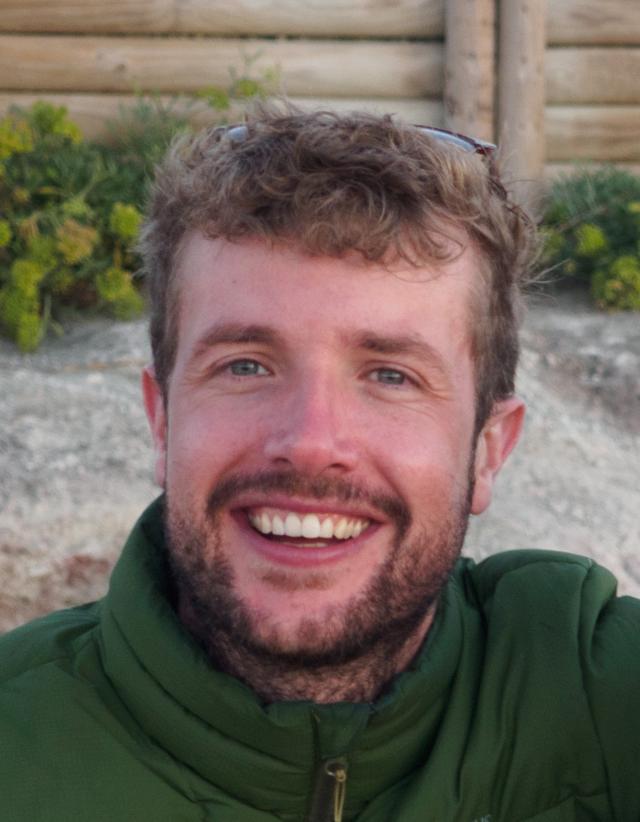
Thomas Fryer, an IMES-based PostDoc, has a wide variety of research interests, including designing snake antivenom and novel antimicrobials.
Mindy Blodgett | IMES
MIT NovoNordisk AI PostDoc Fellow Thomas Fryer, an MIT NovoNordisk AI PostDoc Fellow in the Collins Lab since March 2025, is British, and completed his undergraduate and PhD at the University of Cambridge, studying Biochemistry and applying that to ultra-high throughput protein engineering using droplet microfluidics. He then moved to Copenhagen for two years to complete an Industrial PostDoc focused on developing protein-based inhibitors of many agriculturally and industrially relevant enzymes that lead to food waste or complicate processes. At that time, he also collaborated with a university group to develop the first de novo designed snake antivenom. Read on to learn more about Thomas’ research and background.
What attracted you to the Collins Lab?
I was drawn to the combination of cutting-edge use and development of artificial intelligence and synthetic biology tools whilst also applying those to incredibly important problems such as the antimicrobial resistance crisis.
Can you tell us a bit about your research interests?
I really enjoy building solutions within biological engineering that are both cheaper and better than the status quo, and thus enable more people to address new problems and hopefully find many new solutions to some of the most-pressing challenges of our day. In particular, that has recently been most focused on building de novo protein design pipelines—encompassing innovations across both the computational and experimental screening stages—and applying that to both snakebite antivenom development as well as novel antimicrobials.
What do you enjoy about being at MIT and at IMES?
I love how enthusiastic and curious everyone is about their own, and most importantly, other people’s work. That makes the environment very welcoming!
What are your professional goals?
Ultimately, I want to influence society in a positive way, delivering innovations that increase accessibility to and build new cutting-edge biological engineering tools such that a wider variety of problems can be solved across health, sustainability, etc.
Tell us about your science hero or heroine.
I think the people I can most easily point to as hero/heroines are the new-wave of science communicators on YouTube. Channels like Kurzgesagt or Veritasium that explore science and technology topics in a very accessible yet detailed manner, whilst also emphasising the fun side of curiosity and science.
What do you like to do in your spare time?
I spend most of my spare time playing with my two cats, watching TV shows, playing video games, reading etc. When the weather gets a bit nicer I also love being outdoors in any form.
What is on your bucket list?
I really enjoy traveling, so many places are on my bucket list. Costa Rica has been up there for a long time, and I am excited to actually have a holiday booked to visit there very soon.
What’s the most recent skill you learned?
I recently tried pottery for the first time, and whilst I cannot classify it as a skill it was definitely a lot of fun.
What’s your favorite TikTok, Instagram or YouTube video? Share a link!
I have shared this video with so many friends already. Olivia Dean makes really beautiful fun music, and this video really captures their talent and joy whilst also reminding me of home.
What do you believe is an underrated invention or technology?
Evolution, and particularly its application to real-world problems. I see so much of my world through the lens of evolution, and how impactful it can be completely outside the world of biology, shaping languages, societies etc. When looking through that lens it is easy to understand how certain ways of thinking came to be, and how their selective advantage only works over a short-term time frames rather than for sustainable, long-term survival. I hope that by appreciating that we can begin to build solutions that work over the long-term instead.