

Biswas Fellows advance early-stage ideas at the frontiers of health and life sciences
March 18, 2026
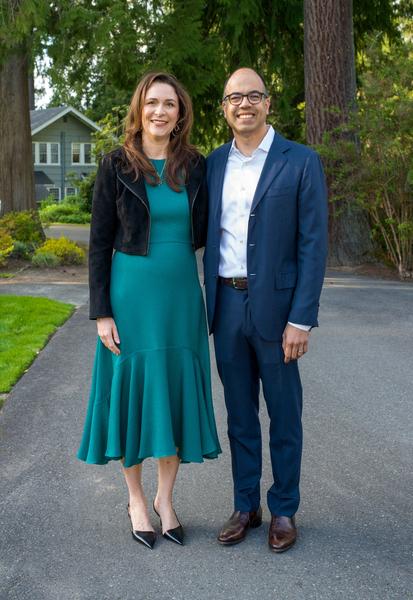
The Biswas Postdoctoral Fellowship Program is supported by a gift from the Biswas Family Foundation, co-founded by Hope Biswas (left) and MIT alumnus Sanjit Biswas SM ’05.
Credits:
Photo courtesy of the Biswas family.
Five early-career researchers have been named Biswas Fellows, joining a growing cohort supported by the MIT Health and Life Sciences Collaborative (HEALS) to pursue bold, interdisciplinary research with the potential to improve human health.
Liam McDonnell | MIT Office of Innovations and Strategy
Supported by Sanjit and Hope Biswas through the Biswas Family Foundation, the Biswas Fellowship is designed to give postdoctoral researchers and advanced graduate students the freedom to explore high-risk, high-reward ideas at the intersection of science, engineering, and medicine—often at a stage when traditional funding is difficult to secure. With the first cohort about to begin their research, the program reflects MIT’s broader effort to accelerate translation in the life sciences by supporting talent early and encouraging collaboration across disciplines.
“Many of the most promising ideas in health and life sciences emerge at early moments when researchers are still foraging for new avenues, connecting fields, and refining their questions,” says Angela Koehler, faculty co-lead of HEALS. “The Biswas Fellowship is intentionally structured to support that exploratory phase—giving fellows the time and stability to take intellectual risks and build collaborations that wouldn’t otherwise be possible.”
While the fellows’ research spans neuroscience, cancer biology, genome engineering, and medical robotics, they share a common focus: developing tools and approaches that could ultimately move from the laboratory toward real-world impact.
“At its core, the Biswas Fellowship is about giving talented young researchers the support to pursue ideas that might not yet fit neatly into existing categories,” says Hope Biswas. “We’re inspired by the curiosity, creativity, and sense of purpose this cohort brings to their work, and we’re excited to see where their ideas lead.”
Understanding and shaping brain states
Adiya Rakymzhan, a postdoctoral associate in the Laura Lewis Lab at MIT’s Research Laboratory of Electronics (Lewis is an IMES core faculty member), studies how fundamental brain states—such as alertness, drowsiness, and sleep—shape cognition and brain physiology. These states are disrupted in many neurological and psychiatric conditions, yet remain difficult to monitor or regulate in real time.
Her research combines multiple brain-imaging techniques, including functional MRI, functional near-infrared spectroscopy, and EEG applied simultaneously to track activity in brain regions involved in arousal and sleep. She is also exploring the use of low-intensity focused ultrasound, a noninvasive technology that can stimulate these regions without surgery.
By integrating continuous monitoring with targeted neural modulation, Rakymzhan aims to lay the groundwork for future tools that could help improve attention, sleep, and overall brain health. “The Biswas Fellowship lets me pursue a high-risk idea at the intersection of engineering, neuroscience, and human physiology,” she says. “It allows us to move quickly from concept to experimentation.”
Engineering cellular communication
Constantine Tzouanas, HST Medical Engineering Medical Physics (MEMP) '25, a postdoctoral researcher in the lab of Sangeeta Bhatia (HST MD '99, HST MEMP '97, core IMES faculty member) is focused on how cells and tissues communicate—and how those signals might be engineered to improve health. His work begins with liver infection but extends more broadly to cancer, autoimmunity, aging, and other diseases.
Tzouanas has developed protein engineering platforms that allow researchers to systematically test signaling proteins across the human genome, applying them to primary human cells and tissues to unlock how specific signals can be targeted to promote healthy functions and drive beneficial disease responses.
With support from the Biswas Fellowship, he is expanding this work toward translational applications. “I’m interested in understanding the signaling language of the human body and learning how to reprogram it,” he says. “The fellowship provides both the freedom and the platform to pursue ideas that connect human needs with cutting-edge technology.”
Targeting an unmet need in brain cancer
Janaina Macedo da Silva, a postdoctoral associate in Forest White’s Lab at the Koch Institute for Integrative Cancer Research, is tackling one of the most challenging problems in oncology: glioblastoma, an aggressive brain cancer for which few effective treatments have emerged over decades of study.
A central obstacle in treating brain tumors is the blood–brain barrier, which prevents many drugs from reaching the brain. Silva’s project focuses on testing a new therapeutic candidate designed specifically to cross this barrier.
Using mouse models and patient-derived samples, she is applying proteomics and phosphoproteomics approaches to study how tumors respond to treatment and how they may adapt or resist therapy. Her long-term goal is to generate insights that could support future clinical testing. “What drew me to the Biswas Fellowship is its emphasis on translating science to real life,” she says. “Ultimately, the goal is to help patients who currently have very limited options.”
Making genome editing more customizable
Rachel Silverstein, who recently completed her PhD at Harvard University and Massachusetts General Hospital, works at the intersection of genome editing and machine learning. Her research aims to make genome-editing technologies safer, more effective, and more customized for specific genomic mutations.
Silverstein applies computational methods to large DNA and RNA sequence datasets, seeking to better understand how biological function is encoded in genomic sequences. During her fellowship at MIT in the lab of Yunha Hwang, she plans to explore RNA-guided systems beyond CRISPR, potentially uncovering new tools for research and therapeutics.
“We’re generating enormous amounts of genomic data, but much of it remains poorly understood,” she says. “This is an exciting moment in science, where computational approaches are finally allowing us to interpret that information and learn from it.”
Improving guidance in cardiovascular surgery
Tom Dillon, a postdoctoral researcher working with Brian Anthony in MIT’s Device Realization Laboratory, focuses on improving the safety and accessibility of cardiovascular surgery. Many procedures are guided primarily by 2D X-ray imaging, requiring surgeons to infer the three-dimensional position of devices inside the body—a process that can increase the risk of complications.
Dillon’s research integrates ultrasound, artificial intelligence, position sensors, and pre-operative imaging such as CT and MRI to provide surgeons with intuitive 3D guidance during procedures like stent placement and heart valve repair.
By combining multiple data streams in real time, his work aims to reduce guesswork and improve outcomes. “The opportunity to work on a high-impact clinical application was a major motivation for me,” he says. “Better guidance tools could make complex procedures safer and more accessible, including in settings with fewer specialized resources.”
A cohort shaped by convergence
Beyond their individual projects, the Biswas Fellows form a cohort intentionally brought together across disciplines and departments, creating opportunities for shared learning, collaboration, and cross-pollination of ideas. While their projects are at an early stage, the fellowship is designed to provide sustained support over four years—longer than a traditional postdoctoral appointment—giving fellows the time, flexibility, and stability needed to pursue ambitious ideas and translate them into meaningful advances.
“What’s striking about this cohort is not just the ambition of their ideas, but the way they bring together engineering, computation, biology, and clinical insight,” says Anantha Chandrakasan, MIT’s provost. “The Biswas Fellowship is designed to create space for that kind of convergence, supporting people at a moment when the right encouragement can shape the trajectory of an entire field.”
As HEALS continues to build programs that connect talent across MIT and beyond, the Biswas Fellowship offers a powerful model for how early investment in people can help accelerate discovery and translation. Applications have opened for a second cohort of fellows, who will begin later this year.
*Originally published in MIT HEALS.