

Judith Richter Lecture: Geoffrey Hinton
Date and time
-
Location
Building 32-123
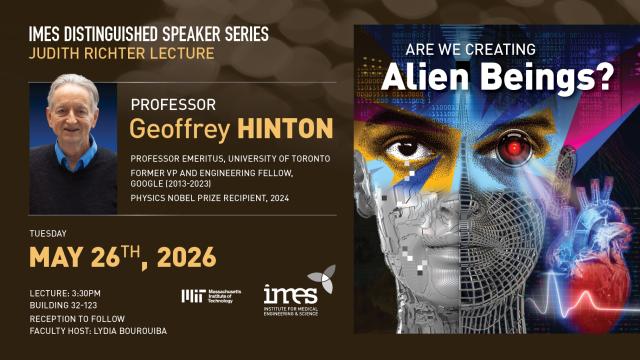
Are We Creating Alien Beings?
Speaker: Geoffrey Hinton, Professor Emeritus, University of Toronto; former VP and Engineering Fellow, Google (2013-2023), Physics Nobel Prize Recipient, 2024
When: May 26, 3:30 pm
Where: MIT Room 32-123
Faculty Host: Lydia Bourouiba, Japan Steel Industry Professor, Director of the Fluid Dynamics of Disease Transmission Laboratory, and co-leads the Fluid and Health Network, IMES, core faculty at IMES.
Reception to follow.
Abstract
I will give a brief and biased history of Al. Then I will explain what it means to understand a sentence and why it is much more like folding a protein than translating into an internal symbolic structure. I will talk about some of the risks of Al, especially the risk that Al will take over. I will speculate on why the public is not more scared of this. In particular, I will address the crazy idea that LLMs are just stochastic parrots and the idea that Als cannot have subjective experience or emotions or genuine desires. I will claim that most people have a completely wrong theory of how the words "subjective experience" work, even though they can use the words to communicate successfully. I will also describe a way of reframing the problem of how we can coexist with superintelligent Al.
Biography
Geoffrey Hinton received his PhD in Artificial Intelligence from Edinburgh in 1978. He did postdoctoral work at the University of California San Diego and spent five years as a faculty member in the Computer Science department at Carnegie-Mellon University. He then moved to the Department of Computer Science at the University of Toronto where he is now a Professor Emeritus. From 2013 to 2023 he worked half-time for Google where he became a Vice President and Engineering Fellow.
He was one of the researchers who introduced the backpropagation algorithm and the first to use backpropagation for learning word embeddings. His other contributions to neural network research include Boltzmann machines, distributed representations, time-delay neural nets, mixtures of experts, variational learning and deep learning. His research group in Toronto made major breakthroughs in deep learning that revolutionized speech recognition and object classification.
Geoffrey Hinton is a fellow of the UK Royal Society and a foreign member of the US National Academy of Engineering and the US National Academy of Science. His awards include the David E. Rumelhart prize, the IJCAl award for research excellence, the Killam prize for Engi-neering, the NSERC Herzberg Gold Medal, the IEEE James Clerk Maxwell Gold medal, the NEC C&C award, the BBVA award, the Honda Prize, the ACM Turing Award, the Princess of Asturias Award, the VinFuture Grand Prize, the Queen Elizabeth Prize in Engineering and the Nobel Prize in Physics.