

Are we creating alien beings?: A lecture by Geoffrey Hinton
May 29, 2026
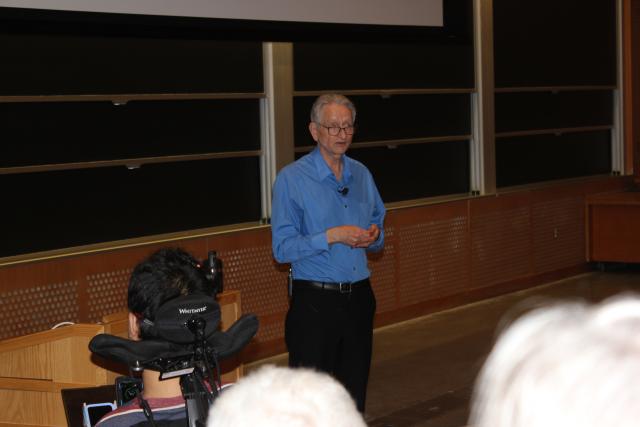
Geoffrey Hinton gives the IMES Richter Lecture on May 26 at MIT.
The “godfather of AI” spoke of how humans have the wrong idea of how “subjective experience” works and how it relates to AI
IMES
Geoffrey Hinton, the 2024 Nobel Prize recipient for Physics who is known as the “Godfather of AI,” gave what he called “a brief and biased history of AI” on May 26th, as the inaugural speaker in the IMES Judith Richter Lecture in Education, Science, and Peace.
The Richter Lecture is part of the IMES Distinguished Speaker Series, was held in the Kirsch Auditorium at the Stata Center, and was a standing room-only event. The faculty host was Lydia Bourouiba, Japan Steel Industry Professor, professor, Department of Civil and Environmental Engineering, and Department of Mechanical Engineering, and a core faculty member at IMES.
Hinton, who is Professor Emeritus, University of Toronto, and a former VP and Engineering Fellow, Google (2013-2023), is a pioneering British-Canadian computer scientist and cognitive psychologist whose fundamental work on artificial neural networks and deep learning made our understanding of modern artificial intelligence possible.
Hinton, who spoke with occasional humor, described how AI works, and addressed the risk that AI will eventually take over for humans. In his talk, called “Are We Creating Alien Beings?”, he proposed how to reframe the challenges, and discussed how to potentially co-exist with superintelligent AI.
The Judith Richter Lecture in Education, Science, and Peace, was established at MIT in 2020 by Dr. Judith Richter, co-founder of the cardiovascular firm Medinol, in celebration of the 20th anniversary of the NIR School of the Heart.
The NIR School is an experiential program Dr. Richter founded aimed at enriching the academic, cultural, social and personal development of promising teenagers throughout the Middle East who come together to learn the basics of cardiology. The academic program was developed in collaboration with Elazer Edelman, former director of IMES, Edward J. Poitras Professor in Medical Engineering and Science, MIT. Dr. Richter spoke at the inaugural lecture delivered by Prof. Hinton, describing the work of the NIR School and sharing a short video.
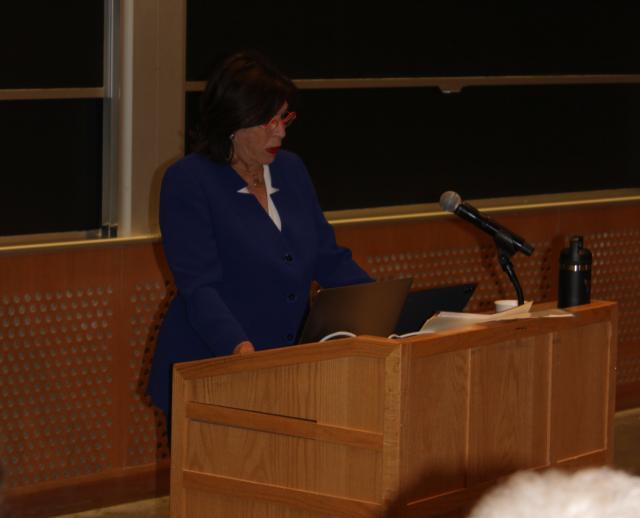
Dr. Judith Richter speaks at the inaugural Judith Richter Lecture in Education, Science, and Peace, delivered by Prof. Geoffrey Hinton, on May 26, 2026
Geoffrey Hinton is a fellow of the UK Royal Society and a foreign member of the US National Academy of Engineering and the US National Academy of Science. His awards include the David E. Rumelhart prize, the IJCAl award for research excellence, the Killam prize for Engi-neering, the NSERC Herzberg Gold Medal, the IEEE James Clerk Maxwell Gold medal, the NEC C&C award, the BBVA award, the Honda Prize, the ACM Turing Award, the Princess of Asturias Award, the VinFuture Grand Prize, the Queen Elizabeth Prize in Engineering and the Nobel Prize in Physics.
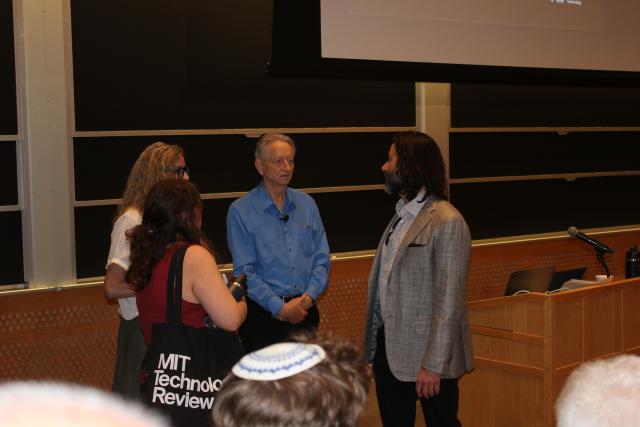
Geoffrey Hinton, left, Alex Shalek, IMES director, right.