

IMES community profile: Giuliano De Carluccio
August 28, 2026
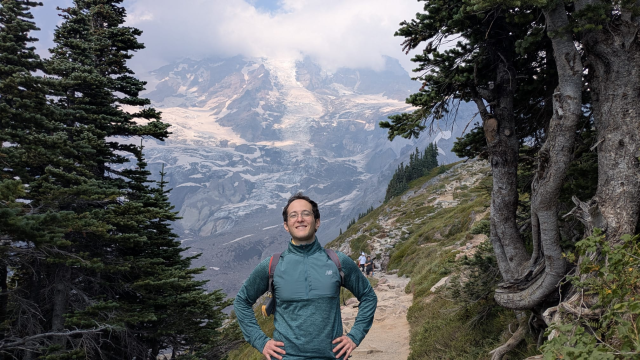
Giuliano De Carluccio is a postdoctoral research associate who grew up in Italy, and who has always loved science.
Mindy Blodgett | IMES
Giuliano De Carluccio, PhD, is a postdoctoral research associate at the Collins Lab at IMES. Originally from Italy, he grew up in a working-class family in Aprilia, a small town near Rome. Read on to learn more about Giuliano.
Can you tell us a little bit about yourself?
Science fascinated me from a very young age. As a kid, I was always experimenting in my room with whatever I could find. One of the first “inventions” I remember being particularly proud of was a small hydrogen generator by water electrolysis I built using parts scavenged from old electronics. Looking back, my experiments were not always the safest, but that instinct to play with things and combine them in new ways never really went away.
I studied Medical Biotechnology at Sapienza University of Rome. During my studies, I became fascinated by the similarities between the way cells sense information, process it, and make decisions and the way computer programs or electronic circuits work. That is when I fell in love with synthetic biology. I then moved to Naples to pursue my PhD in Industrial Bioengineering at the Telethon Institute of Genetics and Medicine (TIGEM). After my PhD, that path eventually brought me from Italy to the Collins Lab at MIT.
Why did you want to join the Collins Lab?
I joined the Collins Lab about three years ago. Jim (Collins) is one of the pioneers of synthetic biology, so for someone who had fallen in love with this field, it was difficult to imagine a more exciting place to continue my training.
I was also attracted by how interdisciplinary the lab is. People approach biological problems from very different directions, combining engineering, machine learning, and molecular biology. I wanted to be in an environment that would push me beyond what I already knew and expose me to new skills.
Have you received any fellowships—and that we should give a shout-out to?
Yes! I’ve been supported by a postdoctoral fellowship from the Ludwig Center at MIT’s Koch Institute for Integrative Cancer Research. I’m very grateful for their support, which has given me the opportunity to pursue an independent research direction at the intersection of synthetic biology and cancer research.
Can you tell us some highlights about your research interests?
I like to think of my research as “playing” with mammalian cells and trying to engineer or steer their behavior using the three major layers of biological information: DNA, RNA, and proteins.
Most of my experience has been in engineering DNA- and RNA-based systems, particularly synthetic gene circuits and technologies that allow us to control how mammalian cells behave. More recently, I’ve become fascinated by de novo protein design and by the possibility of using generative AI to design entirely new proteins with programmable functions. Ultimately, I’m interested in combining these different approaches to build new tools to control cell behavior.
What do you enjoy about being at MIT?
Coming from a small town in Italy, MIT was not somewhere I ever imagined I would end up when I was younger. One of the things I enjoy most is simply how much is happening here. There are always interesting people to meet, seminars to attend, technologies to learn about, and unexpected opportunities to collaborate.
What are your professional goals?
My main goal right now is to develop into a genuinely hybrid experimental and computational scientist. I have spent most of my career on the experimental side of synthetic biology, and I now want to become much stronger computationally, particularly in machine learning and AI-driven biological design.
Longer term, I’m still keeping an open mind about academia versus industry. I know that I would eventually like to bring what I have learned in the US back to Europe, and at the moment I’m particularly attracted to the possibility of working in biotech, where I could combine fundamental science with the development of technologies that eventually reach real-world applications.
What do you like to do in your spare time?
Trying not to fall too much into the Italian stereotype, I really love cooking and sharing food with the people I care about. I think there are more connections between cooking and the wet lab than we might realize. I also love hiking and exploring nature. Since moving to the US, I’ve visited ten National Parks, which has been one of my favorite experiences of living here. I’m also a big fan of strategy video games and board games, and I enjoy building LEGO sets and model kits.
What is on your bucket list?
Professionally, I would really like to properly learn machine learning rather than just understanding it from the outside. It would open up a completely new way for me to approach biological problems. And I’m still at only 10 out of 63 U.S. national parks, so I hope to visit them all one day!