

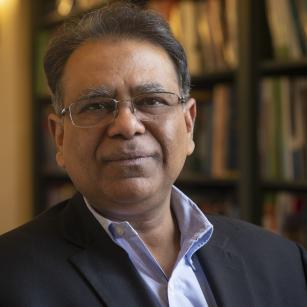
Arup K. Chakraborty, PhD
Core Faculty
Title
John M. Deutch (1961) Institute Professor, MIT
Professor of Chemical Engineering, Physics and Chemistry, MIT
Founding Director of (IMES) Institute for Medical Engineering and Science, MIT
Founding Steering Committee Member of Ragon Institute of MIT, MGH, and Harvard University
Areas of Research
 Computational Biology and Medicine, and Clinical Informatics
 Infectious Diseases and Immunology
Email
arupc [at] mit.edu
Website
Phone
(617) 253-3890
Lab Phone
(617) 258-7040
Lab Fax
(617) 253-7498
Address
77 Massachusetts Ave.
Cambridge, MA 02139
Room
E25-338
Administrative Assistant(s)
Naomh Fairweather
( 617) 324-4976
nfairwea [at] mit.edu
Arup K. Chakraborty, PhD
Core Faculty
Title
John M. Deutch (1961) Institute Professor, MIT
Professor of Chemical Engineering, Physics and Chemistry, MIT
Founding Director of (IMES) Institute for Medical Engineering and Science, MIT
Founding Steering Committee Member of Ragon Institute of MIT, MGH, and Harvard University
Degrees
- PhD, Chemical Engineering, University of Delaware, 1988
Bio
Arup K. Chakraborty is one of the 12 Institute Professors at MIT, the highest rank of a MIT faculty member, which is awarded jointly by the faculty and administration. He holds the John M. Deutch Institute Professorship. He is also a Professor of Chemical Engineering, Physics, and Chemistry at MIT. He served as the founding Director of MIT’s Institute for Medical Engineering and Science, and he is a founding member of the Ragon Institute of MGB, MIT and Harvard. For over 26 years, Chakraborty’s work has largely focused on bringing together approaches from statistical physics, computation, immunology, and virology to understand how the immune system functions. This fundamental knowledge can be harnessed to advance health. His interests span T cell signaling, development of the T cell repertoire, a mechanistic understanding of antibody responses and learning in the immune system, the interplay between physiological adaptation to perturbation and immune responses, and virus evolution. Since 2016, Chakraborty has also been interested in the role of non-equilibrium regulation of phase separation in transcription. Chakraborty is one of the fewer than 30 individuals who are members of all three branches of the US National Academies—National Academy of Sciences, National Academy of Medicine, and National Academy of Engineering. He is also a Fellow of the American Academy of Arts & Sciences, and has received many other honors including the NIH Director’s Pioneer Award, the E. O. Lawrence Medal (DOE), a Guggenheim Fellowship, the Max Delbruck Prize in Biological Physics from the American Physical Society, the Tel Aviv University International Prize in Biophysics, the Colburn, Professional Progress, Alpha Chi Sigma and Prausnitz Institute Lectureship from the AIChE, and three honorary doctorates. Chakraborty has received seven awards for his classroom teaching based on student input. He is the co-author of the book, Viruses, Pandemics & Immunity, and the author of the soon to be published book, Physical Concepts in Immunology.
Research Interests
Infectious Diseases/Immunology/virology; Regulation of transcription; Condensate biology; Statistical Physics and computation
For over two decades, Chakraborty’s lab has focused on understanding the mechanistic underpinnings of the adaptive immune response to pathogens, and then to harness this knowledge to help design better vaccines and therapies. Current interests in immunology can be divided into three broad categories: understanding the network of biochemical interactions that enable T cells to translate engagement of membrane receptors to cognate ligands into functional responses, how T cell development results in T cells that are specific for unknown and emerging pathogens, and the human immune response to HIV, influenza, and coronaviruses. The goal of the last effort is to guide the rational design of vaccines and therapies against highly mutable infectious disease-causing viruses based on an understanding of the pertinent fundamental immunology and virology. Another recent focus is the role of phase separation in eukaryotic gene regulation. In particular, how droplets of transcriptional molecules form at specific genomic loci, and how their functions are regulated by non-equilibrium processes. Chakraborty’s work represents a crossroad of the physical and life sciences. A hallmark of Chakraborty’s research is the close synergy and collaboration between his lab’s theoretical and computational studies (rooted in statistical physics) and investigations led by experimental biologists and clinicians.
Selected Publications
A full list of Professor Chakraborty’s publications can be found on his website.
Courses Taught
- Required Graduate Core subject for Chemical Engineers on Thermodynamics and Statistical Mechanics (10.40)
- Statistical Physics in Biology (HST.452 (J) /8.592)
- Viruses, Pandemics and Immunity (HST.438 (J) /8.245/10.382/5.003)
Description
The Chakraborty Lab is focused on understanding the mechanisms underlying how the immune system functions. This basic knowledge can then be harnessed for the design of better strategies to cure and prevent disease. The lab is also interested in transcriptional condensates. Arup Chakraborty’s work represents a crossroad of the physical, computational and life sciences. A hallmark of his research is the close synergy and collaboration between his lab’s theoretical and computational studies and investigations led by experimental biologists and clinicians.